
VoIP Handsets: Choose the Right Desk Phone
Choose VoIP handsets that suit your calls, teams and network. Compare key features, deployment needs and support considerations before you buy today.
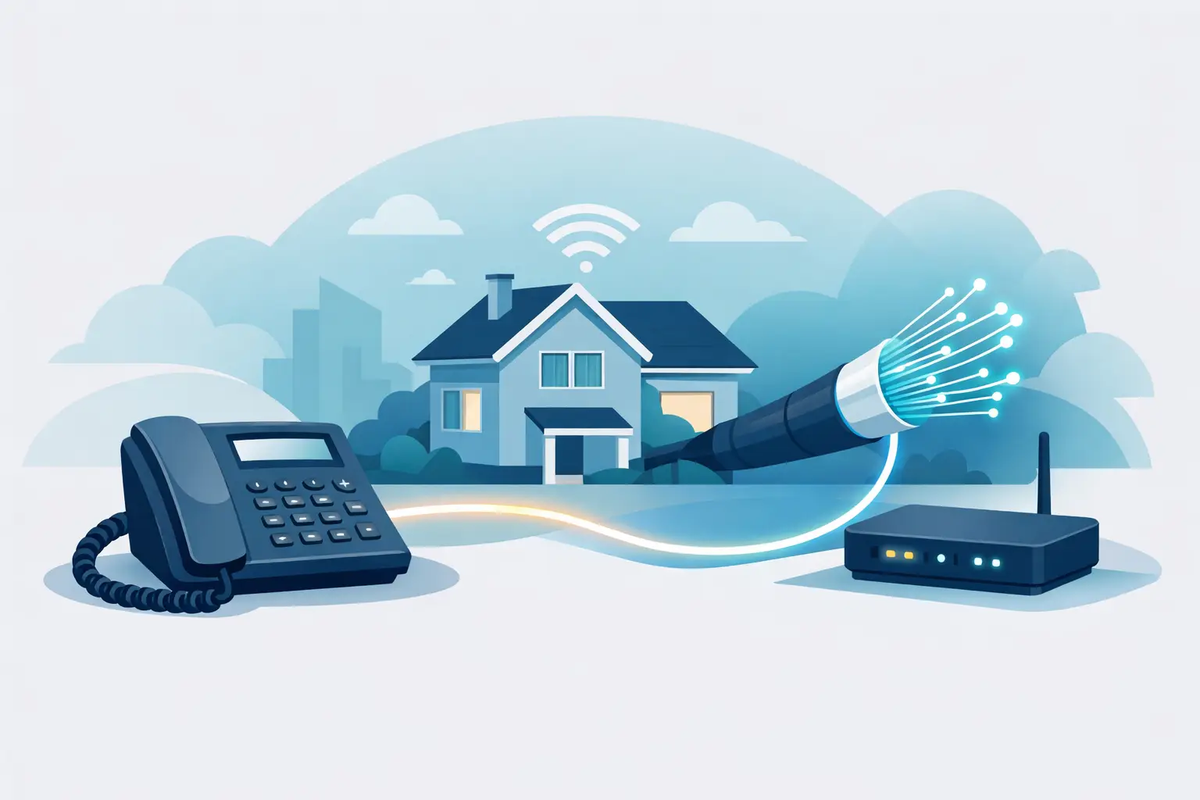
If your broadband is moving to fibre, your phone line is changing too. Home phone over fibre is no longer a niche option for early adopters. It is quickly becoming the standard setup for households that want faster internet without giving up the familiarity of a fixed home number.
That change matters because a fibre connection does not carry voice in the same way as an old copper landline. For many people, the switch is straightforward. For others, especially households using alarm systems, lift lines, medical pendants or older handsets, the detail matters. The right decision starts with understanding what actually changes.
With a traditional landline, your home phone service ran over the copper telephone network. With home phone over fibre, voice calls are delivered digitally over your internet connection instead. In practical terms, you still pick up a handset and dial a number, but behind the scenes the technology is different.
Most providers now deliver this as internet-based telephony. Your telephone plugs into a compatible router, an adapter, or a dedicated voice device rather than a wall socket designed for the old public switched telephone network. The experience for everyday calling can feel almost identical, but the service depends on power and the local broadband equipment working correctly.
That is the key trade-off. You gain a more modern network and usually better long-term compatibility with current infrastructure, but you lose the passive resilience older copper lines often had during a power cut.
Copper networks are ageing, expensive to maintain and limited in what they can deliver. Fibre is built for modern traffic - high-speed internet, TV services, cloud applications, video calls and voice, all on one access network.
For households, this usually means fewer parallel technologies to support. One connection can handle streaming, remote working, online gaming and fixed telephony. For providers, it means more consistent performance and a network that can be managed more efficiently.
There is also a practical point here. As legacy telephone infrastructure is retired in many markets, keeping an old-style landline becomes less realistic over time. If you want to keep a home phone, fibre-based telephony is increasingly the route that makes sense.
In most homes, the fibre service enters the property through an optical network terminal or a fibre router. Your phone service is then provisioned through the provider's voice platform. Depending on the setup, your handset may connect directly to the router's phone port, or you may use a separate analogue telephone adapter.
If you have a cordless DECT phone, the base station normally plugs into the router and the handsets continue to work as usual around the house. If you prefer a corded phone, that can also work, provided the equipment is compatible.
Some households want to keep their existing home wiring and use extension sockets in several rooms. That can be possible, but it depends on how the internal wiring is arranged and whether it has been isolated from the old external copper feed. This is one of those areas where a clean installation matters more than guesswork.
The biggest advantage is future readiness. A fibre-based phone service fits the direction modern telecom networks are already taking. It avoids being tied to infrastructure that is being phased out.
Call quality can also be very good. When the service is properly configured, voice over a fibre connection is clear, stable and consistent. For households that still value a home number, that is a strong point.
It can also simplify your setup. Rather than juggling separate technologies for broadband and telephony, everything is delivered over one access network. That makes it easier to manage services, equipment and support through a single provider.
For some customers, number retention is another major benefit. If your home number is known to family members, schools, doctors, tradespeople or long-standing clients, keeping it while moving to fibre is often far easier than replacing it altogether.
The most important issue is power dependency. An old copper line could often keep working during a local power cut because the line itself carried power. Home phone over fibre usually cannot. If your router or fibre terminal loses power, your phone service stops unless there is battery backup in place.
That does not make fibre telephony unreliable. It simply means reliability now depends on more parts inside the home. If uninterrupted calling is critical, especially for vulnerable residents, backup planning is worth discussing before installation.
The second point is compatibility. Most standard phones work perfectly well, but some legacy devices do not. Fax machines, monitored alarms, payment terminals and telecare devices can be sensitive to the change from analogue copper to digital voice. In some cases they work with the right configuration. In others, they need upgrading or a different connection method.
The third issue is broadband dependency. If your internet service is down, your phone service may also be affected. On a well-managed fibre network that risk is often low, but it is still different from the old model people grew up with.
For most homes, yes. If your priority is reliable calling, a familiar home number and a setup that matches modern broadband infrastructure, it is a practical choice. Families who still use a fixed phone for incoming calls, older relatives who prefer a handset on the table, and households that want one provider for internet, TV and telephony often find it fits well.
It is especially sensible if you are already upgrading to full fibre. Running a separate legacy line just to preserve a home phone rarely makes long-term sense where fibre telephony is available and properly supported.
That said, if nobody in the household uses a fixed line and every call happens on a mobile, keeping a home phone may not add much value. The answer depends less on technology trends and more on how you actually communicate day to day.
This is where you should slow down and check the detail. Burglar alarms, emergency call buttons, care pendants and entry systems can rely on line behaviour that a digital voice service handles differently.
Some devices work perfectly once reconfigured. Others need an IP-ready replacement, a mobile backup module or a dedicated service path. If a household depends on telecare or monitored alarms, the safest approach is to confirm compatibility with both the device supplier and the telecom provider before migration.
For business users operating from home, the same logic applies to card machines, legacy EPOS terminals and specialist communication equipment. Better safe than sorry.
A good provider should be able to answer a few practical questions clearly. Can you keep your existing number? Where will the phone connect? Will your current handsets work? What happens during a power cut? Are alarm and telecare devices supported? Is there local support if the installation needs changes inside the property?
These are not edge-case questions. They are the difference between a service that simply goes live and one that works properly from day one.
Providers with direct control over their network and in-house support usually have an advantage here. When fibre, routing and telephony are managed as one service rather than stitched together, troubleshooting tends to be faster and more accurate. That local accountability is worth more than headline pricing when your home communications need to work without fuss.
The best home phone over fibre package is not always the cheapest one. It is the one that matches how your household uses calls, what equipment you need to keep, and how much resilience matters.
Some homes just need a simple voice service with number retention and a standard cordless phone. Others need multiple handsets, internal wiring support or reassurance around care devices and backup power. Small businesses working from home may even be better served by a more advanced telephony option if call handling matters.
That is why the conversation should start with usage, not just monthly cost. At Visual Online, that practical view is exactly where a better service begins.
If you are moving to fibre, treat your home phone as part of the upgrade, not an afterthought. The technology is ready. The real question is whether the setup has been designed around the way you live.
Choose VoIP handsets that suit your calls, teams and network. Compare key features, deployment needs and support considerations before you buy today.
What internet speed do families need? Learn how streaming, gaming, video calls and smart devices affect broadband needs at home.
Do you often have problems with your WLAN connections? Or do you want to squeeze the last bit of performance out of your mesh? Then you should take a look at this guide. A few simple steps - in the truest sense of the word - can make a big difference.

