
Email fraud
Phishing attack against Visual Online's e-mail users (vo.lu). Visual Online calls on its customers to be vigilant following a phishing attack.
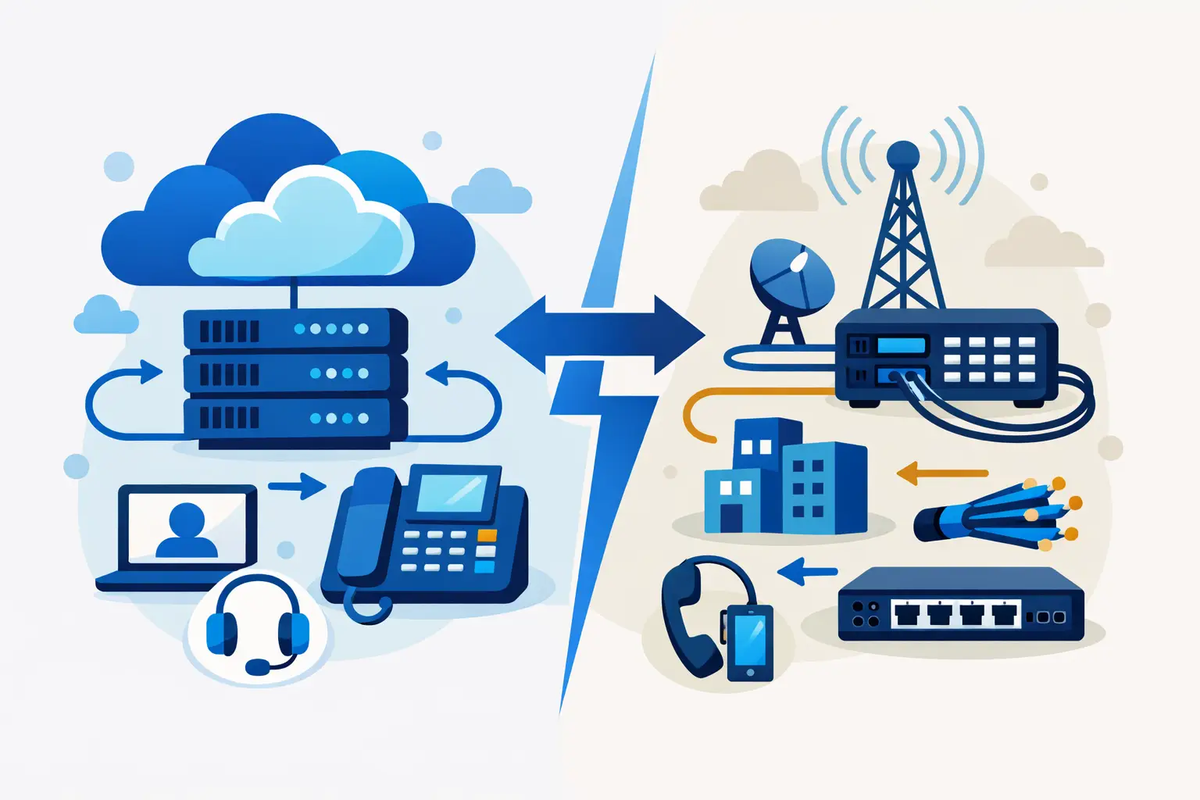
If you are comparing cloud pbx vs sip trunking, you are probably not shopping for jargon. You want a phone system that works, scales properly, and does not create a support headache six months after rollout. That is the real decision - not which acronym sounds more advanced, but which setup fits the way your business actually operates.
For some companies, Cloud PBX is the clear answer because it removes complexity and shifts the heavy lifting into the provider’s platform. For others, SIP trunking makes more sense because they already have a capable phone system on site and want to modernise connectivity without replacing everything. Both can be the right choice. Both can also be the wrong one if selected for the wrong reasons.
The simplest way to understand the difference is this. Cloud PBX replaces the traditional phone system with a hosted one. Your call routing, extensions, voicemail, ring groups and business telephony features live in the cloud rather than on a box in your office.
SIP trunking is different. It does not replace your PBX by itself. Instead, it connects your existing PBX or IP phone system to the outside world over the internet. Think of it as the modern equivalent of traditional telephone lines, but delivered over IP.
That means Cloud PBX is usually a full phone system service, while SIP trunking is usually a connectivity service for a phone system you already own or manage.
This distinction matters because it affects cost, responsibility, flexibility and support. If you choose Cloud PBX, you are usually buying simplicity. If you choose SIP trunking, you are usually buying control and continuity.
Cloud PBX is often the better fit for businesses that want to reduce on-site hardware and simplify day-to-day administration. If your team is spread across multiple locations, works partly from home, or needs an easy way to add and remove users, a hosted model is usually easier to manage.
It also suits companies that do not want to maintain an ageing PBX in a comms cupboard and hope it keeps going. With Cloud PBX, there is no need to patch and babysit a legacy system, source rare parts, or rely on one person in the business who happens to know how the phone setup works.
The benefits are practical rather than theoretical. New users can often be added quickly. Features such as voicemail to email, call queues, business hours routing and softphone access are normally built in. Moves and changes are less disruptive because the intelligence sits in the platform, not in a single office location.
For smaller firms, this can mean faster deployment and more predictable monthly costs. For growing companies, it can mean fewer technical bottlenecks. For customer-facing teams, it can mean more consistent call handling across office, mobile and remote users.
That said, Cloud PBX is not automatically cheaper in every case. Over time, per-user licensing can add up, especially for larger businesses with simple calling needs. And if you require very specific integrations, niche call flows or unusual compliance requirements, a standard hosted setup may need careful checking before you commit.
SIP trunking usually shines when a business already has a PBX that still does its job well. If your current system supports the features your team needs, replacing it just to follow a trend may not be the smartest investment.
In that case, SIP trunking lets you modernise the connection layer while keeping your internal telephony logic in place. You retain your own PBX, your own call plans and often more direct control over how the system behaves.
This approach can work very well for businesses with in-house IT capability, specialist telephony requirements or a recent investment in IP PBX hardware. It can also make sense where there are analogue or digital line services to retire, and the goal is to move to IP without redesigning the entire phone environment.
There can be cost advantages too. If the PBX is already paid for and still fit for purpose, adding SIP trunks may be more economical than moving every user onto a hosted licence model. Businesses with a high number of users but relatively stable telephony needs often look closely at this route.
The trade-off is that SIP trunking does not remove responsibility for the PBX itself. Someone still needs to manage that system, update it, secure it and troubleshoot it when something breaks. If your PBX is old, hard to maintain or dependent on outdated hardware, SIP trunking can extend its life - but it does not solve the underlying age problem.
Cost comparisons are where many buying decisions go wrong, because people compare only the monthly line item and ignore the rest.
Cloud PBX usually has lower upfront cost because there is less equipment to buy and install. That can make it attractive if you want to avoid capital spend. The monthly fee is typically predictable, which helps with budgeting.
SIP trunking may look cheaper month to month if you already own the PBX and only need channel capacity and call services. But that picture changes if your system needs maintenance, upgrades, specialist support or replacement parts. A low monthly service cost can hide a high ownership cost.
It is better to compare total cost over three to five years. Include handsets, licences, support time, failover planning, setup work, internet resilience and the cost of business disruption if something fails. The right answer often becomes clearer when you stop treating telephony as a line rental and start treating it as business infrastructure.
A common mistake in the cloud pbx vs sip trunking debate is assuming one is reliable and the other is not. In reality, reliability depends heavily on network quality, configuration and provider competence.
Cloud PBX can be very dependable, especially when backed by strong infrastructure and properly managed endpoints. But if your office internet is unstable, call quality will suffer regardless of how modern the hosted platform is.
The same goes for SIP trunking. A well-configured PBX with resilient connectivity can perform extremely well. A badly maintained PBX with weak firewall rules and no fallback plan can become a serious risk.
This is where working with a provider that understands both connectivity and telephony makes a tangible difference. Businesses in Luxembourg, for example, often benefit from dealing with a local operator that controls more of the stack and offers direct access to people who can actually investigate a fault rather than simply log a ticket. That saves time when telephony is tied to customer service, sales and daily operations.
If control is your top priority, SIP trunking often wins. You keep your PBX, shape your dial plans, manage integrations and decide how far you want to customise the environment. That flexibility can be valuable for businesses with advanced workflows.
But control has a cost. More control usually means more technical responsibility, more maintenance and more chances to get things wrong.
Cloud PBX gives up some of that hands-on control in exchange for easier management. For many businesses, that is a good trade. They do not need to tweak every telephony parameter. They need phones to ring in the right place, reports to be available, and changes to be handled without turning into a project.
So the better question is not which gives you more control, but how much control you truly need.
Start with your current setup. If your PBX is outdated, difficult to support, or limiting the way your team works, Cloud PBX is often the cleaner long-term move. If your existing system is modern, stable and matched to your needs, SIP trunking may be the smarter upgrade path.
Then look at how your business is changing. If you are opening locations, supporting hybrid work, or expecting headcount shifts, Cloud PBX tends to handle change more gracefully. If your operations are stable and your telephony requirements are specialised, SIP trunking may preserve useful investment.
You should also be honest about internal capability. If no one in your business wants to manage telephony infrastructure, do not choose a model that depends on exactly that. Simplicity is not a compromise when it reduces operational risk.
Finally, think beyond the product. The quality of onboarding, number porting, call flow design and human support often has more impact on your experience than the technology label itself. A well-delivered service beats a theoretically perfect architecture that nobody supports properly.
There is no universal winner in cloud pbx vs sip trunking. There is only the option that fits your business today, and the one that will still fit when your needs change. The smart move is to choose the setup that solves real problems now without creating avoidable ones later.
Phishing attack against Visual Online's e-mail users (vo.lu). Visual Online calls on its customers to be vigilant following a phishing attack.
Learn how to manage VoIP queues with sensible routing, live reporting and clear service standards, so callers reach the right person sooner, every time.
Our email domain setup guide explains professional addresses, DNS records, authentication and the checks that keep business messages deliverable every day.

