
Dedicated IP Versus Shared IP: Which Fits?
Dedicated IP versus shared IP explained: see how address reputation, email delivery, hosting costs and control affect your Luxembourg business choices.
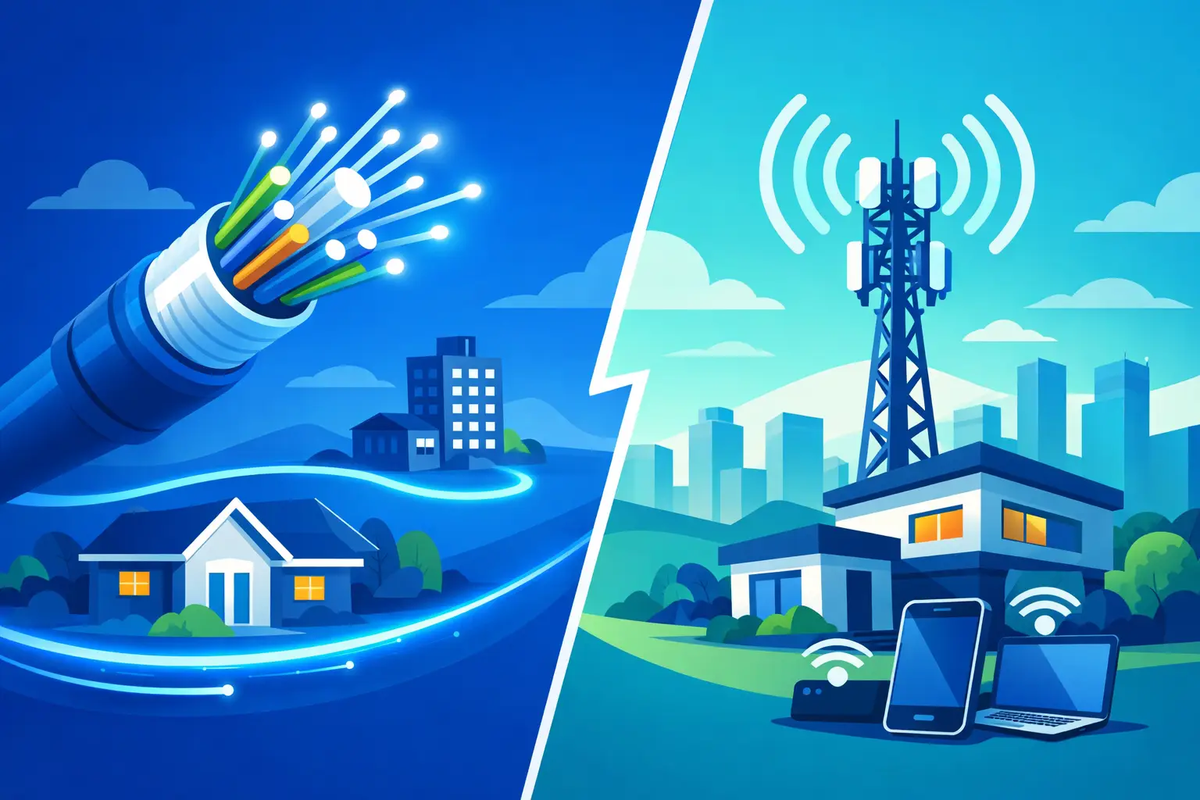
A video call freezes just as you need to make a decision. A large cloud backup takes all evening. The match buffers when everyone in the house gets online. These are the moments when the fibre internet vs 5G question becomes more than a technical comparison.
Both technologies can deliver high speeds, but they do so in very different ways. Fibre is a fixed connection built around physical optical cables. 5G is a wireless mobile network that sends data over radio signals. One may be the better fit for your address, your work patterns and the way your household or business operates.
Fibre internet carries data as light through fibre-optic cables directly to a property. It is designed to provide a dedicated fixed connection with very high capacity, consistent performance and low latency. Once installed, it does not depend on the strength of a nearby mobile signal or on conditions between your building and a mobile mast.
5G uses the latest generation of mobile network technology. It can provide fast internet to phones, tablets and wireless routers, making it particularly useful when travelling, working away from the office or connecting a location where fixed infrastructure is not yet available. A 5G home router turns that mobile signal into Wi-Fi for your devices.
The distinction matters because a speed test is only one part of the experience. A connection that is fast at 10:00 might perform differently during a busy evening, in poor indoor coverage, or when several people are transferring large files at once. For fixed locations where performance matters every day, consistency is often just as valuable as headline download speed.
5G can achieve impressive download speeds, particularly in areas with strong coverage and limited network congestion. For browsing, social media, video streaming and occasional work at home, this can be more than sufficient. It also avoids waiting for a new fixed line to be installed where a quick connection is needed.
Fibre is built for sustained capacity. It is especially well suited to households with multiple heavy users and businesses that transfer data throughout the day. Think of several 4K streams, online gaming, cloud applications, video calls, security cameras and backups happening at the same time. Fibre is designed to keep that activity moving without each demand competing for a variable wireless signal.
Upload speed deserves attention too. Many people focus on downloads, yet uploads matter whenever you send files, synchronise cloud storage, publish content, join high-quality video calls or run business services from a site. Fibre packages commonly offer stronger and more predictable upload performance than wireless alternatives. For a company sharing project files or using cloud telephony, that difference can be felt every working day.
Latency is the time it takes for data to travel between your device and its destination. Lower latency makes interactions feel more immediate. It is relevant to online gaming, voice and video calls, remote desktop sessions, payment systems and cloud-based business applications.
Fibre generally provides lower, steadier latency because the connection follows a fixed physical route. 5G latency can be very good, but it may vary with signal quality, local demand, router placement and the network configuration serving your location. That does not make 5G unsuitable for calls or gaming. It means users who depend on consistently responsive connectivity should look beyond a single speed result.
A fibre cable is not affected by the walls, glazing, floor level or nearby buildings around your property. With suitable internal networking, it offers a stable foundation for the whole site.
5G performance is more location-sensitive. A router near a window may work noticeably better than one in a cupboard. Building materials, terrain and distance from a mast can all influence the result. Local demand also matters: wireless capacity is shared across users in an area, so performance can change at peak times.
For this reason, 5G should be assessed where it will actually be used. Check coverage at the property, test signal strength indoors and consider whether the connection remains dependable during the times your household or team is busiest.
Fibre is usually the right long-term connection for a home or business that is fixed in one location and relies heavily on the internet. It brings predictability to activities that do not tolerate interruption well, from remote work and streaming to hosted systems and customer calls.
For families, fibre provides the headroom to let everyone use the internet at once without having to manage who is downloading, watching or playing. It is also a better base for whole-home Wi-Fi. The incoming line is only part of the picture, but a quality router and well-planned Wi-Fi coverage can carry fibre performance to the rooms where it is needed.
For businesses, fibre supports more than everyday browsing. It can underpin cloud applications, VPN access, hosted telephony, large file transfers, off-site backups and guest Wi-Fi. A stable fixed connection also gives IT teams a clearer baseline when diagnosing problems. If a service slows down, they can investigate the local network, devices or application rather than first questioning radio conditions.
Fibre is particularly compelling when downtime has a cost. A professional services firm missing calls, a retailer unable to process payments or a team locked out of shared cloud tools needs more than a connection that is fast on a good day. It needs dependable infrastructure and accountable support when something does not work as expected.
5G is not simply a lesser substitute for fibre. Its mobility is its advantage. A phone or 5G router can provide connectivity on the move, at temporary sites or in places where installing fixed access would be impractical or delayed.
It can also be a sensible option for lighter internet use in a property with excellent coverage. A single occupant who streams, browses and works occasionally from home may value the flexibility of wireless access more than the capacity of a fixed line. The same applies to pop-up offices, events and construction sites that need internet without a permanent installation.
For businesses, 5G can have an important role as a backup path. If the primary fixed connection is interrupted, a properly configured mobile connection can keep essential devices, cloud systems or telephony services available. The exact setup depends on which services are critical and how quickly they need to recover, but the principle is straightforward: different technologies can reduce the risk of a single point of failure.
The trade-off is that 5G should not be chosen solely on an advertised maximum speed. Before relying on it as the main connection, test it in the building, at busy times and with the devices you intend to use. Confirm any data allowances, network management policies and equipment requirements as well.
Start with the location. If fibre is available and the connection will serve a permanent home, office or shop, it will normally provide the most stable platform. Then consider the number of users, the importance of upload speed and whether low latency is essential. A graphic designer sending large files has different needs from a household that mainly watches television online.
Next, consider how failure would affect you. If losing connectivity for an hour means lost revenue, missed appointments or an unproductive team, plan for resilience rather than choosing one technology in isolation. Fibre as the primary connection and 5G as a backup can be a practical combination for organisations with clear continuity requirements.
Finally, do not overlook the network inside the building. Even the fastest line cannot compensate for weak Wi-Fi coverage, an outdated router or poorly placed equipment. Position the router openly and centrally where possible, use wired connections for fixed high-demand devices, and extend Wi-Fi coverage where the building requires it.
For homes and businesses in Luxembourg, the best answer is often clear once the address, usage and expectations are assessed properly. Visual Online combines local infrastructure knowledge with real in-house people who stay with a problem until it is resolved. Choose the connection that fits the way you work and live, then make sure the network around it is ready to perform.
Dedicated IP versus shared IP explained: see how address reputation, email delivery, hosting costs and control affect your Luxembourg business choices.
Learn how to choose SIP trunking for clear, dependable business calls, matching capacity, security, network quality and human support to your needs.
Compare IMAP versus Exchange email for home and business use. See how syncing, calendars, security and support shape the right choice for your setup.

